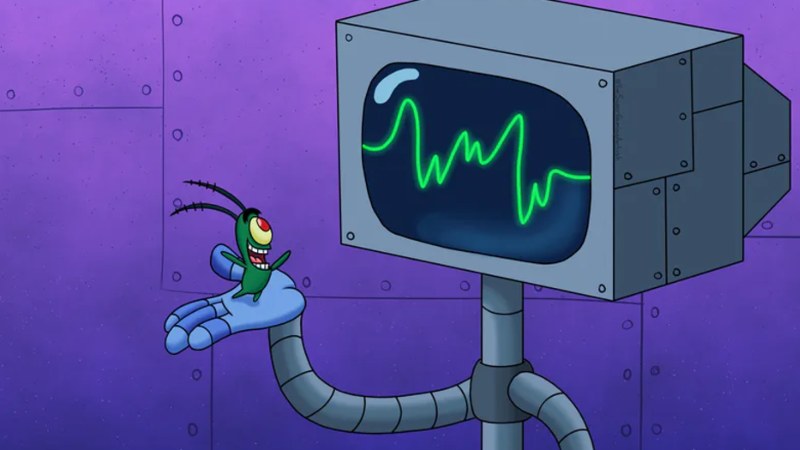
Have you ever watched that one silly cartoon SpongeBob SquarePants? So Karen runs numbers Plankton could never manage alone, scanning formulas and drafting contingency plans. She guesses which way Mr. Krabs might turn next. None of it has ever cracked the safe. Year after year, the Krabby Patty recipe sits exactly where it always has, two doors down from the Chum Bucket, inside a kitchen Plankton can only catch in glimpses through a window or a hastily planted camera. Karen is sharp. She is also boxed in, fed only what somebody bothers to type into her, and that single limit explains more about modern business technology than most quarterly reports ever will.
A surprising number of companies operate the way Plankton does, full of sharp planning and thin sight. They have dashboards. Forecasts come from years of transaction data. What many of them lack is a working set of eyes on the floor and the loading dock, the exact spot where plans meet concrete, and that is precisely the space computer vision development services were built to fill. Put plainly, the work of teaching cameras and software to read a physical room in real time has stopped being a research curiosity and become something closer to a basic requirement for any firm that wants its digital plans to survive contact with a warehouse floor. Plankton never needed a better brain. He needed a second pair of eyes that didn’t blink.
A Wife Built for a Screen
Karen’s trouble was reach, not processing power. Every scheme Plankton hatches starts the same way, heavy on data and heavier still on contingency trees stacked three deep. Karen handles the thinking part well. What she cannot do is glance across the street and notice that Krabs changed the lock, or that he hired a new fry cook who hums the old recipe under his breath while he works. She is locked indoors. A submarine with no periscope.
Plankton’s failures were never really about intelligence. They were about distance, the kind that opens up between a sharp plan and the messy room where that plan actually has to work. A spreadsheet can be flawless and still know nothing about the smell of a kitchen at noon.
The Same Trouble, Just With Better Furniture
Replace Karen with a forecasting model, and Plankton’s problem turns out to be everywhere in commerce right now. 88% of organizations already use some form of AI in at least one business function, a sharp jump from the year before. Yet the same research found that most of those firms have not pushed the technology past pilots and small experiments, stuck exactly where Plankton has been stuck for years.
Many of those same companies have spent the past two years pouring money into large language models: chatbots that draft emails and answer customer questions before a human gets pulled in. Inside those tools, the intelligence stays confined to text boxes and call transcripts. None of them watches a loading dock or notices a spill near aisle nine.
The pattern repeats wherever a screen and a warehouse share the same company. Take a retailer modeling markdown timing perfectly, still losing money on shelves nobody restocked, because no algorithm knew a shelf had gone empty until a clerk wandered past. A factory can run a flawless production schedule on paper and still ship a batch of cracked housings, since no manager can stand at every station for every shift, day after day. Retail has turned into one of the fastest-moving corners of this field.Computer vision spending there is now growing quicker than in almost any other sector, as SKU recognition and checkout systems move out of pilot programs and onto real sales floors.
Giving the Algorithm a Window
The fix isn’t a smarter Karen. It’s a camera that reports back honestly, paired with software trained to make sense of what it sees, and increasingly that work falls under custom computer vision development built around one specific factory, store, or yard rather than an off-the-shelf trick. Pair that camera with the language model already answering customer emails, and a business finally has both halves Plankton never managed to put together: the brain and the eyes. A handful of patterns show up again and again once a company starts down this road:
- Quality inspection that catches a cracked weld or a mislabeled bottle the moment it passes a camera, not after a customer writes in to complain.
- Shelf and inventory tracking that flags an empty hook within minutes, rather than waiting on the next scheduled walk-through.
- Safety monitoring that notices a worker without a harness near an open edge faster than any supervisor covering four floors at once.
- Yard and loading-dock tracking that tells a dispatcher which truck sits where, instead of a radio call and a guess.
Quality inspection alone accounts for roughly 41% of global computer vision spending, more than any other single use case. That number says something quiet but firm about where the money has actually started moving: away from pilots, and straight into the parts of a business that touch a physical product.
Where Computer Vision Development Partner Fits, and Why Now
Firms like N-iX have spent the last few years building exactly this kind of bridge for clients who already had the analytics half-finished and only needed the eyes. The work tends to start narrow, a camera on one production line, maybe a single storefront, then widens once the data proves itself out. Nobody hands a factory floor over to a vision system on day one. Trust gets earned the slow way, frame by frame, until the system stops surprising anyone.
What changes once the eyes show up is not the strategy underneath. It’s the distance between that strategy and the floor where it actually has to live. A retailer’s forecasting model gets sharper once it knows, in real time, which shelves sit empty. For most companies, sitting on strong data and thin floor visibility, computer vision development is where that exact gap finally closes, one trained model and one mounted camera at a time.
Conclusion
Plankton never lacked ambition, and Karen never lacked horsepower. What sat missing between them was the seeing part, the piece no spreadsheet has ever solved on its own. Krabs, for what it’s worth, never once had to change the recipe. Nobody capable of actually watching him cook it had been built. Most businesses today sit closer to Plankton than they would likely admit, and the fix has very little to do with smarter software and almost everything to do with finally giving it a window.